Showing posts with label Puri. Show all posts

Monday, June 20, 2016

Craftsmen of the Gods

Three temple-shaped chariots tower over the sea of humanity at the Grand Road in Puri. It is that time of the year again when the Trinity — Lord Jagannath and His divine siblings Lord Balabhadra and Devi Subhadra — travel to their aunt’s house from the 12th century Jagannath Temple for an annual sojourn, riding their respective chariots. The occasion is Rath Yatra, the biggest religious festival of Odisha. While Lord Jagannath’s Nandighosha chariot is 45 feet high, Devi Subhadra travels in the 43 feet high Debadalana and Lord Balabhadra rides the 44 feet tall Taladhwaja. These architectural marvels are carefully crafted by a team of 75 carpenters under the watchful eyes of three Mukhya Biswakarmas (chief carpenters)— Bijay Mohapatra, Krushna Chandra Maharana and Nrusingha Mohapatra— within a 58-day deadline that begins on Akshya Trutiya. The Mukhya Biswakarmas belong to a lineage of temple servitors who have been assigned this service for several generations.

Each of them works with a team of 25 carpenters. Every year, Bijay takes charge of building Nandighosha (the biggest among the three) for Lord Jagannath, while Nrusingha and his carpenters build the Taladhwaja. Eighty-three year-old Krushna, the eldest of the three chief carpenters, constructs Debadalana for Devi Subhadra. The three had last year also built new idols of the Trinity in the temple for the Nabakalebara. The Rath Yatra’s history is several centuries old, but the traditional style of making the chariots has not changed. 


Nrusingha, Krushna and Bijay
A wooden log in front of the wheels serves as the manually operated brake in the chariot, which is pulled by lakhs of devotees. Last year, 17 feet high and 16-inch wide Sal logs were used as brakes in each of the three chariots,” informed 55-year-old Bijay, whose involvement in making the Nandighosha chariot began at the age of 11.

The unique feature of chariot construction is that all the measurements are done by hand span. “We have never used a scale or measuring tape. Our forefathers used to measure the logs with their hands,” recalls Bijay. The Mukhya Biswakarmas say a total of 42 wheels are required for the three chariots, with 16 wheels for Nandighosha, 14 for Taladhwaja and 12 for Debadalana. Nrusingha says that making the wheels is the most important part of the construction. “The chariots are made with Phasi logs and over 5,000 pieces of wood are required. Once the logs arrive in Ratha Khala (chariot construction yard), we select 70 carpenters who size them for the chariots. We lay special focus on sizing the wheels because if they are not proportionate, chariots will not move safely,” he adds.


Nrusingha has been making chariots for the last 14 years. The frame and wheels are decorated with colourful designs inspired from Odishan temple architecture. The frames are then covered with intricately embroidered green, black, yellow and red cloth, which are embellished with Pipili applique craft and brass figures. Bijay and Nrusingha hope to construct chariots for 10 more Rath Yatras before they allow their successors to take over. Krushna, on the other hand, has already started training his four grandsons . “This is hereditary work and it has to continue, come what may. We are bound by the wishes of Lord Jagannath,” the Trinity’s carpenter says with a smile.

The story was first published in The New Indian Express

Saturday, December 12, 2015

A Martial Heritage On the Wane

 
Paika Akhada members perform at PMG Square in Bhubaneswar

Paika Nrutya, the traditional battle dance of the State, might have withstood the test of time, but the number of akhadas (training centres) in Odisha is gradually on the decline. Blame it on an apathetic Government, lack of promotional avenues and funding.
The dance revolves around acrobatic movements with swords, lathis (sticks), chakras (wheels) and dhalis (shields) to the accompaniment of 'Chagi', 'Mahuri', 'Nagara' and cymbals. In the ancient times, Paika Nrutya by the warriors was considered a rehearsal for the battle.

Scholars have compared Paika Nrutya to Kalaripayattu of Kerala, considered the oldest fighting system in existence, because of its approach to traditional weapons and techniques, but the former does not enjoy the patronage that the latter does. In fact, Kerala has been successful in converting Kalaripayattu into a tourism product whereas in Odisha, Paika Nrutya is limited to a handful of villagers in rural areas. 
Today, Paikas can only be seen performing during Dussera, Kali Puja, birth anniversary celebration of Harekrushna Mahatab and the Dhauli Kalinga Mahotsav. Besides, the Jobra puja committee at Cuttack has been organising Paika Nrutya competitions every year on Vijaya Dashami day from 1921.

History Behind the Form

The martial prowess of Paikas finds mention in Sarala Das' 'Mahabharata', written in the 15th century, poet Balaram Dash' work 'Jagamohan Ramayan' and even in the carvings on the Sun Temple at Konark. Historians said when the British started meddling with the revenue system of the State in 1803, the farming community rose in rebellion. At that juncture, Bakshi Jagabandhu Bidyadhar, the military chief of the King of Khurda, revolted on April 2, 1817. As Bidyadhar led his army of Paikas, the British were forced to retreat. The rebellion came to be known as Paika Bidroh. Also, it was due to the Paikas that the Britishers did not find it easy to win over the Barunei Fort at Khurda, which is said to be the last free fort of the country to go to the British.

Successors of the Fighter Tribe

While officially, there is no information on the exact number of akhadas existing in the State today, unofficial sources put the number of Paikas still practicing the martial dance form at around 20,000 in the districts of Khurda, Dhenkanal, Ganjam, Puri, Gajapati, Talcher and Balasore. The maximum number of akhadas exists in Khurda. "If the Nrutya is performed today, it is because of the stage shows that offer money for sustenance. There is no encouragement from the Government's side," says Gyana Ranjan Mohanty, a Puri-based acrobat who performs Paika Nrutya and Malkhamb. He says the existing forms of Malkhamb, Sahi Yatra, Ranapa, Dhemsa, Chhau and Naga Nacha have been born out of Paika Nrutya.


Dance or a Sport?

Ileana Citaristi, who has authored a book 'Traditional Martial Practices of Odisha' and carried out extensive research on the subject, feels Paika Nrutya is currently in a no man's land. Government is yet to classify it as a performing art or a form of sport as a result of which, it does not come under either the Sports Department or Culture Department. “This is why, no one pays attention towards it propagation and whatever little is being done for its promotion is half-hearted," she says, adding that although Paika training exists in rural areas of the State, it is not systematic. Not all the Paikas are adept in every form of the martial dance. "Only a few can play with a sword and shield today. You will not find the entire gamut of the martial art in any of the akhadas; what can be seen is mostly martial exercises like Banati, Lathi Khela, Chakra Ladhei, pyramid formation and somersault," Ileana adds.

No Paika Training Centres

Currently, there are no Government training centres where Paikas can be trained. Even as a training centre for Paikas was opened by the Government at Gurujang near Khurda in 1998, the institution did not function beyond two years. The akhadas do not have a curriculum and all forms of martial exercises in Paika Nrutya are not covered as far as training is concerned.
Founder-Director of Rani Sukadei Regiment of Talcher, the only all-women Paika Akhada in the State, Soubhagini Debi who is also the principal of Silpanchal Women's College in Talcher, says Paika Nrutya, which is an integral part of Odisha's history, should be presented at important State festivals so that today's youth come to know about it. "It is a dying art form and only some Gurus have kept this tradition alive. There is a need for establishing training centres for Paikas with provision of scholarship for youths who wish to learn it. Whatever training is being imparted now is at individual level and we do not know if our students would be interested in carrying forward the tradition," she says.

Commemorating Paika Rebellion

Culture Minister, Ashok Panda, who admitted to the lack of patronage to Paika Nrutya, said in commemoration of 200 years of the Paika rebellion that will be observed in 2017, the Culture Department has planned a series of events with the Paikas. "Also, we will be taking steps for protection and conservation of Khurdagarh fort, and Barunei that was the religious place where Paikas used to worship before setting out for war," he informs.

Tuesday, November 10, 2015

Celebration of A Different Kind


Diwali is a unique celebration in Odisha. Here, the 'Festival of Lights' is not just limited to customary bursting of crackers and exchange of lip-smacking sweets, but also accompanied by Kali Puja and the ritualistic ceremony of 'Badabadua Daka'. The celebrations are special in the Millennium City of Cuttack, Coastal town of Bhadrak and the very-popular Pilgrim Town of Puri.

At Cuttack, festivity is a never-ending affair during this part of the year. Just a fortnight after Durga Puja, the city braces up for Kali Puja that coincides with Diwali, a celebration of victory of good over evil. Keeping up with the saying 'Baara Mase Tera Parba' (13 Festivals in 12 Months of A Year), people of Cuttack celebrate Kali Puja and Diwali with much fervour and gaiety. Although the celebrations are not as grand as Durga Puja, the revelers are no less enthusiastic.
The Kali Puja here is over 500-years-old and it is believed that Bengalis brought this tradition to Cuttack during the 16th century. This year, around 70-odd puja committees are worshipping Kali, another form of Goddess Durga.


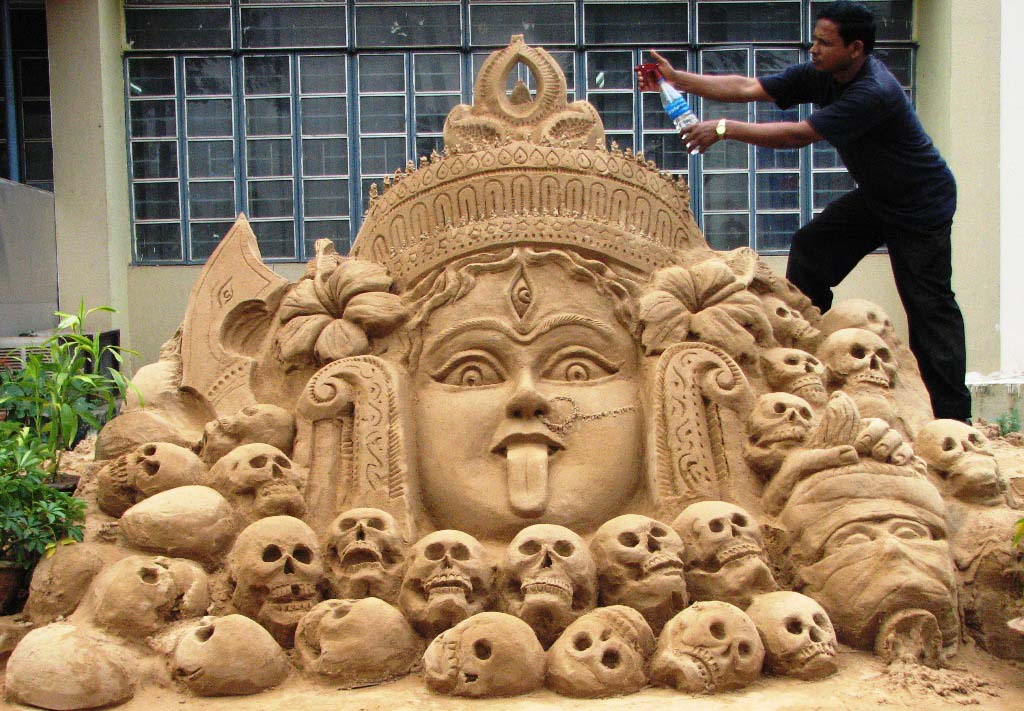
A majority of the temporary pandals house a particular iconography of Goddess Kali, who steps on Lord Shiva wearing a garland of human skulls and her tongue piercing out. This form is called 'Tara'; her colour is blue and she is shown naked to the waist, wearing a garland of human heads and then clad in tiger skin. The only puja committee that worships the 'Chhinamasta' form of the deity is the Bakhrabad Kali Puja Committee. Here, the deity holds her own severed head in one hand and a scimitar in another.
Three jets of blood spurt out of her bleeding neck and are drunk by her severed head and two other attendants. Instead of standing on Lord Shiva, the Goddess steps over an embracing man and woman on a lotus.


Like Durga Puja, the idol of Goddess Kali at several pandals is accompanied by a silver backdrop (Chandi Medha). Bhikari Das, general secretary of Cuttack Mahanagar Peace Committee said this year, at least 23 idols of Goddess Kali are being set up with Chandi Medhas. While the same backdrop is used for both Durga Puja and Kali Puja in other pandals, only Bakhrabad has a different tableau for the Tantric Goddess. Designed with traditional silver filigree work, the tableau depicts the scene of a cremation ground with two skeletons standing beneath a large banyan tree besides, jackals, owls, and swans being the dominating motifs. Two years back, the Bakhrabad puja committee prepared a beautiful golden crown to the deity. Some of the other Kali Puja pandals worth seeing are the ones at Ranihaat, College Square, Bajrakabati, Khan Nagar, Tulasipur, Bangali Sahi, Choudhury Bazaar and Sutahaat. Kali Puja begins on November 10 and culminates with Diwali. All the idols will be immersed on November 14.


In Bhadrak, Kali Puja is celebrated in a grand way owing to the presence of Bhadrakali temple. Like Durga Puja in Cuttack, Kali Puja in this coastal town is a week-long affair that is witnessed by lakhs of people. While a large number of devotees throng the Bhadrakali village, on the outskirts of Bhadrak town, several glittering pandals are erected in Charampa area to house the deity.

Likewise, Puri witnesses a grand gathering on the day of Diwali as people observe 'Badabadua Daka' to pay obeisance to their ancestors. In the unique ritual, people gather outside the 12th century Jagannath temple and burn jute sticks (known as Kaunriya Kathi in local parlance) inviting their ancestors to descend from heaven on Diwali and bless them. The burning of jute sticks is accompanied by a prayer 'Badabadua Ho Andhaare Aasa, Aalua Re Jao (Ancestors, come in darkness and go back along the lighted path). With thousands of bundles of jute sticks being lighted on the day, the Grand Road in front of the Jagannath temple offers a beautiful spectacle.


 Trips To Roads Less Travelled Wishes All Its Readers A Very Happy, Safe and Eco-friendly Diwali. Eat. Pray. Enjoy.

Wednesday, September 30, 2015

A Cultural Kaleidoscope That Puri Is

 Puri has always been a fresh canvas to the photographer’s eye. The centuries-old town exudes a raw charm and unforgettable warmth. TRLT brings you glimpses of different colours and tastes of the town, captured during a recent photo walk.

The 12th century Jagannath Temple at Puri


Aruna Stambha Outside the Jagannath Temple. It is said that Aruna is the  charioteer of God Surya. The Pillar is 32-ft-high and is made of high-quality granite. Lord Aruna is sitting atop Pillar with folded hands looking towards the Deities.

The sculpture of a Lion preying on an Elephant beneath the Aruna Stambha
Devotees at the Lion's Gate of Jagannath Temple


Khaja, also known as Pheni, is a very famous Odia sweet and it is one among the Chappan (56) varieties of 'bhog' (Mahaprasad) offered to Lord Jagannath. Legends say Lord Jagannath appeared in the dream of a man from Puri and instructed him how to prepare it.
Hardly two kilometres away from the Temple, begins the Puri Beach, a destination that certainly needs no introduction.  The Puri beach is the most popular beach in Odisha and the largest in the country. It stretches up to seven km and is a round-the-year destination for both domestic and international travellers. Visitors can enjoy both the sunrise and the sunset, sunbathe, sit back on the beach and watch local fishermen pulling their catch or mending their nets and listen to the melodious rendition of the striking waves.

Compared to other beaches in the country, the Puri Beach is considered to be safer as it does not face high tide and undercurrent very often. High tides occur only during full moon, so taking a bath in the sea is an enjoyable experience. The area near the beach is dotted with hotels and lodgings for travellers of all categories. For food lovers, there are several shacks along the beach selling fried and grilled seafood like prawns, crabs and pomfrets, freshly caught from the sea, along with vegetable pakodas. There are also many shops selling Odisha handlooms and seashell handicrafts. There is a lighthouse which remains open from 4 pm to 6 pm. One can get a spectacular view of the sea and the beach from the top of the lighthouse. 

The view outside my window at the OTDC Hotel
 

A tea shop by the Sea
 

Fishermen get busy checking their nets after returning with a Catch from the Sea

Their Catch

Shells for Sale
Clouds Approach the Puri Beach

Overcast
An old building in the vicinity
 Puri offers a lot in terms of places to eat. Being a Beach Town, Puri is a sea-food lover's paradise. There are shacks on the beach that prepare the seafood caught by the local fishermen. Select your fish, get it prepared and savour it watching the sunset.
While Odia and Bengali delicacies are easy to find, one can also check out restaurants offering Italian, Continental and Awadhi cuisine. Even pure vegetarian restaurants are not hard to find. Try Promphet Fry at 'Gaan' restaurant of Fort Mahodadhi, Prawn Sizzlers and Desi Chicken at Wild Grass or a delectable choice of Pastas and Pancakes at Hotel Honey Bee Bakery and Pizzeria.  


Rice Noodles and Chicken at Hotel Lee Garden. Head to this beautiful place if You want to taste authentic Chinese food

Chicken Curry at OTDC

Puri Sabzi for Breakfast

Honey, Banana Pancake with Ice-cream at Hotel Honey Bee Bakery and Pizzeria

Pasta with Tomato sauce, Sausage, pickled Olives and some India Masalas at Honey Bee Bakery and Pizzeria. The place is small but they serve awesome food

OTDC plays a perfect host
It starts raining in the evening
Lush green land on the outskirts of Puri


 Travellers' Info: 
Puri is located at a distance of 59 km from Bhubaneswar by road and 63 km by rail. Visitors can either hire a taxi or take a bus to Puri. There are plenty of options for accommodation near the Beach area. Best time to visit is from July to February.   Places to see nearby are the Sun Temple at Konark, Raghurajpur Crafts Village, Satpada, Chilika Lake and Alarnath.

Wednesday, June 3, 2015

Deba Snana Purnima

Gajanan Vesha of the Trinity on the occasion of Deba Snana Purnima in Puri

Lord Balabhadra, Devi Subhadra and Lord Jagannath atop the Snana Bedi before the bathing rituals

Snana Mandap at Jagannath Temple in Puri
The 12th Century Jagannath Temple in Puri
 Here are some glimpses of the Deba Snana Purnima of Lord Jagannath, Devi Subhadra and Lord Balabhadra at Puri, which was celebrated on Tuesday. As per the rituals, the Trinity were taken to the bathing altar at the outer complex of Jagannath temple where they were bathed with 108 pitchers of aromatic and herbal water that was taken out from the Suna Kua (golden well) near Maa Shitala inside the Uttara Dwara (north gate) of the temple.

The Gajapati Dibyasingh Dev - the foremost servitor of the Lord - arrived at the Snana Mandap for Chhera Pahanra (sweeping of the Snana Mandap with a golden broom) atop the Snana Bedi. After performing a complex set of rituals, the servitors decked the Trinity in Gaja Besha, incarnation of Lord Ganesh. The priests then offered 'bhog' to the deities before allowing public for Sahana Mela (public darshan).

The Sahana Mela which began at 6 pm and continued till 11 pm. Late in the night, the deities were escorted to a solitary place in the temple complex, 'Anasar Ghara' (sick room). The deities, supposedly suffering from fever after taking the bath, would retire to bed for 45 days. During this time public darshan is closed in the main temple and representative deities are placed in the sanctum sanctorum. With the Nabakalebara of the Trinity being observed this year, they  will have a 'Maha Anasara' for 45 days, 30 days more than the usual 'Anasara' held every year. The temple physician would treat the deities in the sick room with herbal medicines in this period.  


As per religious belief, during Anasara period Lord Jagannath manifests in Alarnath Dev in Brahmagiri. Devotees in large numbers rush to Alarnath temple, 23 km from Puri and offer Kheer Prasad.


Friday, May 29, 2015

Bold Troupers of a Folksy Dance Cult


Gotipua dancers ready for a show
By Diana Sahu

Raghurajpur, the first heritage village of Odisha situated on the banks of river Bhargabi, is known worldwide for its Pattachitra. Bylanes of this quaint little village, where every house is a canvas, are also home to another beautiful art form—Gotipua. At the far end of the village, stand two organisations that have been nurturing Gotipua with all its pristine flavour and glory—Dasabhuja Gotipua Odissi Nrutya Parishad and Abhinna Sundar Gotipua Nrutya Parishad.


 World-renowned Odissi guru Kelucharan Mohapatra was a Gotipua dancer in his early days. To continue the tradition, the organisations have given the dance form a new lease of life amidst cultural apathy within the state. The Dasabhuja Gotipua Odissi Nrutya Parishad was established by late Guru Maguni Charan Das, the pioneer of Gotipua dance, almost four decades ago. Sebendra Das, brother of Guru Maguni Das, currently runs the Dasabhuja Parishad. He explains the relevance of the dance form. “Gotipua is an amalgamation of two Odia words; Goti means single and Pua means boy. When the dance of the Maharis and the Devadasis of the Jagannath Temple at Puri disintegrated due to various reasons, young boys from various ‘akhadas’ were trained to take the tradition forward. Earlier, Gotipua used to be performed by a single boy, but over the years it evolved as a group dance.” 


The Abhinna Sundar Gotipua Nrutya Parishad has been working for the promotion and popularisation of the ancient dance form for 11 years. It was set up by late Guru Laxman Maharana. “A boy who masters all the three skills of singing, playing folk musical instruments and dancing is considered a true Gotipua. In Odissi, a dancer is restricted to dance,” says Priyabrat Pallai, the guru at Dasabhuja Parishad.
He feels that Gotipua is a poor man’s dance. “Such is the plight of Gotipua that not many cultural organisations in Odisha provide a platform for the artistes during their annual festivals. In fact, our boys perform more outside Odisha. Even the Culture Department has stopped organising its annual Gotipua Festival that was started in 2011,” rues Pallai.

It is believed that most of the grammar and material of the present day Odissi repertoire were distilled from Gotipua that originated as a temple ritual for Lord Jagannath. Movements in the two dance forms are same. The style and approach is different. The uniqueness of Gotipua is its combination of song and dance by boys between five and 15 years, who dress up as girls. They perform to verses on Radha and Krishna written by the Vaishnavite poets of Odisha.


Gotipua is gaining global recognition for its rawness and exuberance. “Though Odissi got the classical status due to proper documentation and promotion by connoisseurs, no such effort has ever been made for Gotipua. It is mainly practised in villages by boys mostly coming from BPL families,” says Abhinna Parishad’s Basanta Kumar Moharana, who recently took a batch of students on a dance tour to Paris.


Both the organisations follow the traditional ‘gurukul’ form of teaching and practise the Raghurajpur ‘gharana’ of Gotipua. Dasabhuja Parishad and Abhinna Parishad have trained more than 300 Gotipua dancers from Puri district. Currently, 35 boys are undergoing training at Dasabhuja Parishad and 15 in Abhinna Parishad. For both the parishads, finance has been a concern. The future is uncertain. “There have been years when we have done 100 shows across the world at a stretch and at times, we get to do just 20 to 30 shows in a year. Stage shows abroad fetch good money. Besides, we earn by performing at all festivals related to Lord Jagannath like Rath Yatra, Chandan Yatra, Jhulana, Dola Yatra,” Basanta adds. 

- dianasahu@gmail.com
Related Posts Plugin for WordPress, Blogger...