Showing posts with label Dussehra. Show all posts

Thursday, October 22, 2015

Cuttack's Golden Durga Puja

The First Golden Durga Puja Idol in Cuttack
In the Silver City of Cuttack, Durga Puja is unique in more ways than one. While the neighbouring State of West Bengal hosts the autumn festival with theme-based pandals and idols, Odisha’s Millennium City of Cuttack decorates the Mother Goddess with gold and silver. The extravagance is reflected in 150-odd Puja Pandals across the city; while the elite puja committees go for gold jewellery and silver backdrops spending several crores of rupees, their smaller cousins opt for just silver.

The Durga idols are usually 20-ft-high and they are accompanied by even taller backdrops (Silver tableaux). The price rise of gold has never been a deterrent for the Durga Puja Committees in Cuttack who make it a point to decorate the majestic tableaux elaborately with silver filigree work, known as Chandi Medha in local parlance, and idols of Goddess Durga, Lord Ganesh, Kartik, Goddess Lakshmi and Saraswati with gold jewellery and crowns every year. Cuttack is known worldwide for its silver filigree craft and filigree artisans who have created several masterpieces with impeccable artistry in the past. Durga Puja is also an occasion for these artisans to showcase their craftsmanship.


While initially, puja committees used to decorate the Goddess and the tableau with silver filigree work and jewellery to create that dazzle, the trend of adding gold to the deity’s idol was started by the Choudhury Bazaar Puja Committee in 2002, which coincided with its golden jubilee celebration. Durga Puja in Choudhury Bazaar began way back in 1956. The organisers made a golden crown of 7.6 kg for Goddess Durga and since then, they have added golden crowns and other jewellery items to the accompanying deities. Of late, the silver tableau is also being converted into a gold one. While the total cost of the Chandi Medha and idols exceeds Rs 15 crore, the puja committee keeps adding some more gold to the entire structure every year.

Subsequently, a group of other puja committees gave a golden touch to their pandals. The Sheikh Bazaar Puja Committee made a 3.5 kg gold crown in 2008 for the deity’s idol that is set against the backdrop of a beautifully carved silver tableau. Over the years, it added gold crowns and necklaces to idols of other deities and even the demon Mahisasura.

At Mangalabag Puja Pandal, not just the Durga idol, the other deities too sport golden crowns weighing at least 2 kg and at Chauliagang Puja Pandal, the Goddess is adorned with a 3 kg majestic golden crown fashioned in the shape of a peacock that is decorated with precious stones. In 2004, the Ranihat Puja Committee prepared a 4 kg gold crown for the Goddess at the cost of Rs 1 crore. While the puja at Ranihat was started a century ago, the committee set up a silver backdrop in 2004.
According to the Cuttack Mahanagar Puja Committee, the apex body of community puja organisers in Cuttack, there are at least 21 puja committees in the city who have silver backdrops and six puja pandals where the deities are adorned with gold crowns and jewellery.


Chandi Medha at Chandni Chowk
The Durga Puja history of Cuttack dates back to several centuries. It is believed that it was Saint Chaitanya Dev who started worshipping the deity during his visit between 1512 and 1517 AD. During his stay at Gadagadia Ghat in Cuttack, he started Durga Puja at Balu Bazaar. Even at Balu Bazaar, a 30-ft-high silver tableau adorns the pandal and the idol here is painted with only organic colours.


The Durga Medha at Chauliagang in Cuttack

For More Pictures, Do Visit My Facebook Page Odisha Dekho


The First Durga Medha in Cuttack at Balu Bazaar

Tuesday, October 20, 2015


Trips to Roads Less Travelled Wishes All Its Readers A Very Happy Durga Puja

Monday, October 19, 2015

The Unique Two-armed Devi of Odisha

The Goddess in Biraja Kshetra has only two hands and the prototype of this image is found nowhere else in the country
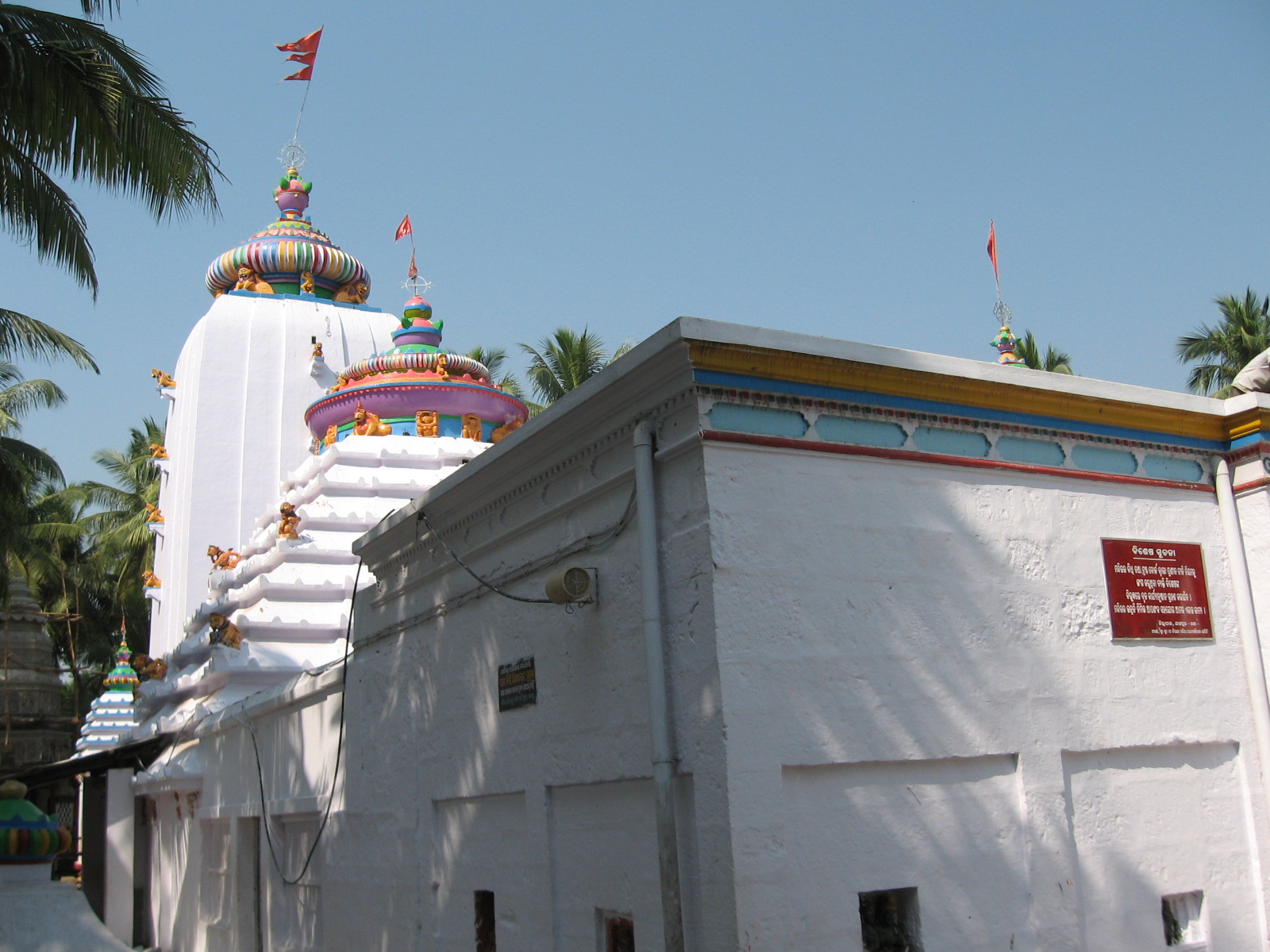
Odisha is home to several sculptural representations of Mahisasuramardini Durga. One of the rarest representation, though, is of the two-armed Goddess at Biraja temple, also known as Biraja Kshetra in Jajpur district. Here, Goddess Durga is worshipped by the name of Biraja and historians believe this to be the earliest representation of Shakti Cult in Odisha.  

Located in Jajpur town, the present 70-ft-high temple housing the two-armed Goddess was built in 13th century while the idol dates back to the pre-Gupta or Gupta period. In fact, historian Sunil Patnaik says the idol might date back to 2nd century AD. The Goddess in Biraja Kshetra has two hands, in one hand she pierces the chest of Mahishasura with a spear and in other, she pulls tail of the demon.
The Mahishasura is depicted as a buffalo and the presiding deity's right foot presses the head of the animal. She wears a crown that has the symbolism of Lord Ganesha, a Shiva Linga and a crescent moon and a Shivalinga. The prototype of this image is found nowhere else in the country.
Apparently, the perimeter of the Biraja Kshetra is triangular in form and the extreme points of the triangle in western, south-eastern and north-eastern directions are guarded by Shiva Lingams, who are regarded as guardian deities of the Kshetra. Goddess Biraja is seated in the circumcenter of the triangular region. According to the temple management, the temple was renovated by Pratap Rudra Dev of Suryavanshi Gajapati dynasty.
While the temple complex has many other temples of Lord Shiva, Hanuman, Goddess Bagalamukhi and Markandeswar, the added attraction is a holy  pond 'Brahmakunda', which lies to  the northwest and close to the Biraja temple. The pond is so named as it is believed that Lord Brahma had conducted a yagna here.


 Maheswar Panigrahy, Sub-Collector of Jajpur and also the Chairman of Biraja Temple Managing Committee, says the temple sees a footfall of at least 1000 devotees everyday. On occasions like Durga Puja and Savitri, the footfall rises to 35,000 daily.  One of the most interesting aspects of Devi worship at Biraja Kshetra is Rath Yatra of Goddess Biraja, which is held during Dussehra. Her chariot, Shimhadhwaja, carries the deity in a ceremonial procession around the temple compound once a day for nine days.  There is a greater inflow of devotees to the temple from Southern Indian States like Andhra Pradesh, Karnataka and Tamil Nadu besides, the neighbouring West Bengal.
Panigrahy further says the State Government is now considering to develop a religious circuit comprising the Biraja temple, Baldevjew temple in Kendrapara, Sarala temple in Jagatsinghpur and Akhandalmani temple in Bhadrak. In fact, the Tourism Secretary LN Gupta had recently urged the Union Tourism Secretary Vinod Zutshi to consider inclusion of Biraja temple-Sarala-Akhandalamani-Baladevjew-Lalitgiri- Ratnagiri-Udayagiri under 'Swadesh Darshan' scheme of the Ministry.

Travellers Info

The temple is located at a distance of 125 km from Bhubaneswar and can be approached by road and rail. It has all amenities for tourists and for accommodation, the Odisha Tourism Development Corporation (OTDC) has a Panthasala. Besides, there are the PWD Bunglow and Circuit House in Jajpur town. Best time to visit is between October and January.


Related Posts Plugin for WordPress, Blogger...