Showing posts with label Cuisine. Show all posts

Tuesday, November 10, 2015

Celebration of A Different Kind


Diwali is a unique celebration in Odisha. Here, the 'Festival of Lights' is not just limited to customary bursting of crackers and exchange of lip-smacking sweets, but also accompanied by Kali Puja and the ritualistic ceremony of 'Badabadua Daka'. The celebrations are special in the Millennium City of Cuttack, Coastal town of Bhadrak and the very-popular Pilgrim Town of Puri.

At Cuttack, festivity is a never-ending affair during this part of the year. Just a fortnight after Durga Puja, the city braces up for Kali Puja that coincides with Diwali, a celebration of victory of good over evil. Keeping up with the saying 'Baara Mase Tera Parba' (13 Festivals in 12 Months of A Year), people of Cuttack celebrate Kali Puja and Diwali with much fervour and gaiety. Although the celebrations are not as grand as Durga Puja, the revelers are no less enthusiastic.
The Kali Puja here is over 500-years-old and it is believed that Bengalis brought this tradition to Cuttack during the 16th century. This year, around 70-odd puja committees are worshipping Kali, another form of Goddess Durga.


A majority of the temporary pandals house a particular iconography of Goddess Kali, who steps on Lord Shiva wearing a garland of human skulls and her tongue piercing out. This form is called 'Tara'; her colour is blue and she is shown naked to the waist, wearing a garland of human heads and then clad in tiger skin. The only puja committee that worships the 'Chhinamasta' form of the deity is the Bakhrabad Kali Puja Committee. Here, the deity holds her own severed head in one hand and a scimitar in another.
Three jets of blood spurt out of her bleeding neck and are drunk by her severed head and two other attendants. Instead of standing on Lord Shiva, the Goddess steps over an embracing man and woman on a lotus.


Like Durga Puja, the idol of Goddess Kali at several pandals is accompanied by a silver backdrop (Chandi Medha). Bhikari Das, general secretary of Cuttack Mahanagar Peace Committee said this year, at least 23 idols of Goddess Kali are being set up with Chandi Medhas. While the same backdrop is used for both Durga Puja and Kali Puja in other pandals, only Bakhrabad has a different tableau for the Tantric Goddess. Designed with traditional silver filigree work, the tableau depicts the scene of a cremation ground with two skeletons standing beneath a large banyan tree besides, jackals, owls, and swans being the dominating motifs. Two years back, the Bakhrabad puja committee prepared a beautiful golden crown to the deity. Some of the other Kali Puja pandals worth seeing are the ones at Ranihaat, College Square, Bajrakabati, Khan Nagar, Tulasipur, Bangali Sahi, Choudhury Bazaar and Sutahaat. Kali Puja begins on November 10 and culminates with Diwali. All the idols will be immersed on November 14.
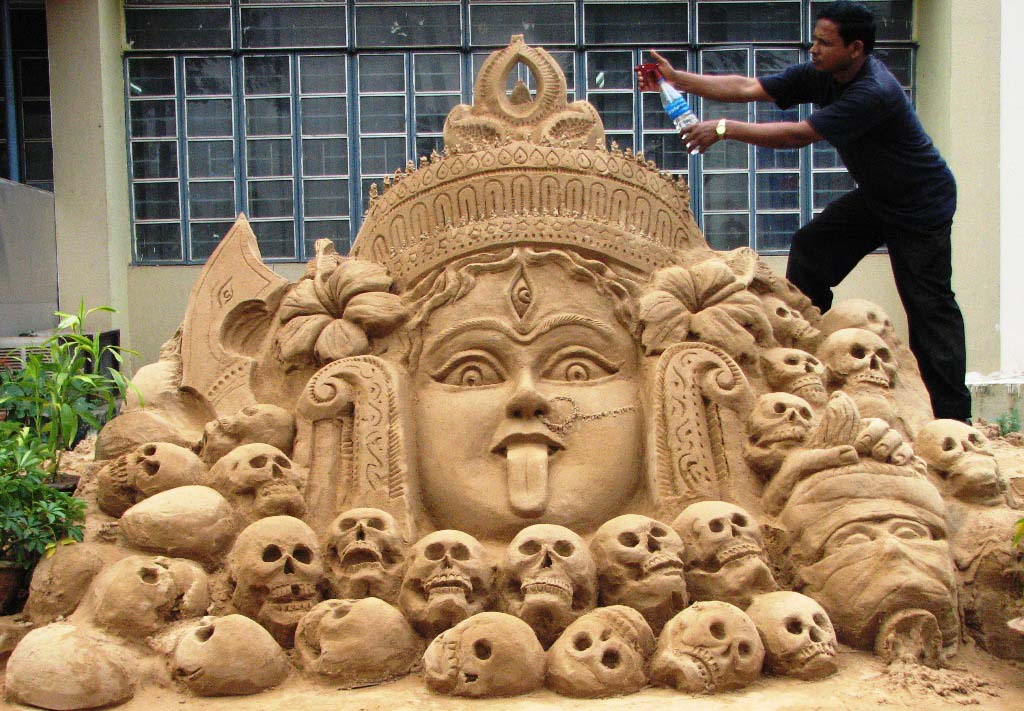

In Bhadrak, Kali Puja is celebrated in a grand way owing to the presence of Bhadrakali temple. Like Durga Puja in Cuttack, Kali Puja in this coastal town is a week-long affair that is witnessed by lakhs of people. While a large number of devotees throng the Bhadrakali village, on the outskirts of Bhadrak town, several glittering pandals are erected in Charampa area to house the deity.

Likewise, Puri witnesses a grand gathering on the day of Diwali as people observe 'Badabadua Daka' to pay obeisance to their ancestors. In the unique ritual, people gather outside the 12th century Jagannath temple and burn jute sticks (known as Kaunriya Kathi in local parlance) inviting their ancestors to descend from heaven on Diwali and bless them. The burning of jute sticks is accompanied by a prayer 'Badabadua Ho Andhaare Aasa, Aalua Re Jao (Ancestors, come in darkness and go back along the lighted path). With thousands of bundles of jute sticks being lighted on the day, the Grand Road in front of the Jagannath temple offers a beautiful spectacle.


 Trips To Roads Less Travelled Wishes All Its Readers A Very Happy, Safe and Eco-friendly Diwali. Eat. Pray. Enjoy.

Thursday, August 20, 2015

Odisha's Sweet Saga


Rarely does a vehicle cross the National Highway 5 stretch between Cuttack and Bhubaneswar, without stopping at Pahala, Odisha’s biggest market selling rasagollas.

Unlike other places in the country where the ubiquitous sweetmeat is spongy and has a rubber-like texture, here the sweet delights are extremely soft, served hot and taste divine. They are prepared fresh everyday with no additional flavouring or any preservative; the only ingredients are chenna (cottage cheese), semolina, sugar and a hint of elaichi  (cardamom) for flavouring.

There are three markets selling rasagolla in Pahala – the Kalinga, the Prachi and the Laxmi; the biggest one being the Prachi market. These have around 120 confectioners who sell the sweetmeat for around 18 hours a day. Their small shops with thatched roofs are not fancy enough to lure customers except for the mouth-watering rasagollas. Icing on the cake is you get two other chenna-based sweet varieties: chenna poda and chenna gaja.

The confectioners belong to the small village of Pahala, located near the National Highway stretch. They do not believe in competition and interestingly, the sweets taste the same in all the shops. The rasagollas are prepared everyday late in the night. Chenna is kneaded with semolina and elaichi powder for about 15 minutes, shaped into small round balls and boiled in sugar syrup of thick consistency. The cheese balls are cooked in syrup till they start floating.


Among the three, making chenna poda (cheese cake) is the most arduous job.  At least 10 kg of cottage cheese is kneaded with semolina and sugar till it becomes light and airy. The dough is then baked overnight in an aluminium container covered with Sal leaves over a clay chulah (stove). Chenna gaja is deep-fried cheese soaked in sugar syrup. Recipes of these sweetmeats have been passed down from generation to generation but so far, there has been no change in the ingredients or the process of making the sweets, whose shelf-life is limited to just one or two days. Every day, the three markets do a business of several lakhs by selling sweets directly to customers and sending rasagollas to different parts of State. 

Odisha-based food historian, Usharani Tripathy says the tradition of making rasagollas is related to the Jagannath Culture. “In Puri during Bahuda Yatra when Lord Jagannath returns to His temple after a nine-day sojourn at Gundicha temple, He offers rasagollas to His wife Goddess Laxmi to pacify her. She is angry with him for not taking her along to Gundicha temple during Rath Yatra. This tradition is being followed for several decades now,” says Tripathy. Many believe that the precursor to Rasagolla was Kheer Mohan, which was offered to the Trinity at the Jagannath temple in Puri. Later, this evolved into the Rasagolla found in Pahala.

Saturday, July 4, 2015

Scripting A Seaside Story


A rainy morning at Nimapara
The road to Konark from Nimapara
 A date with the beach is always a welcome break from the mundane lives that we lead. So on a cloudy Sunday morning, I and four of my colleagues set out for a joyride to the Ramchandi beach from Bhubaneswar, the Capital City of Odisha. Adding a magical touch to our journey was the overcast sky. There is something extremely romantic about beaches during monsoon, I believe.
Our car passed through a narrow diversion road, potholed at some places, from the Bhubaneswar-Puri National Highway towards Konark that houses one of the 25 cultural World Heritage sites in the country, the ornate Sun Temple. From Konark, the Ramchandi beach was just 9.8 km away through the Puri-Konark Marine Drive road.
En route to Ramchandi, we stopped at a small town, Nimapara, for a quick breakfast. It had started drizzling by then.


The popular Chennai Jhili of Nimapara. It is believed that Aarta Sahoo of Shyam Sundarpur village near Nimapara had first come up with the recipe of this Cheese delight
Odisha is home to several mouth-watering sweets and Nimapara holds the reputation of making the soft and sweet 'Chenna Jhili', prepared by kneading Chenna (cottage cheese) into small round balls which are then deep fried and soaked in sugar syrup of thin consistency.
Passing through small roadside eateries, we decided to stop at one - a single room shop with two benches in the centre and one at the right. Its kitchen was a small cabin located just behind and food was being prepared right in front of our eyes. The shop owner-cum-cook offered us idlis with matar tarkari (peas curry) and one piece of Chenna Jhili each. The idlis weren't fluffy but the matar tarkari was piping hot, something that we needed to beat the monsoon chill. The winner on the plate, however, was the extremely soft and mildly sweet Jihili that melted in the mouth. No wonder food historians and critics say, none can match Nimapara confectioners when it comes to making Chenna Jhilis.


Irresistible Aloo Chop
Behind us in the kitchen, Aloo Chops (boiled potato balls dipped in spiced gram flour batter and deep fried) were just out of the frying pan. An irresistible aroma of fried besan and aloo filled the air. After sipping a glass of tea, we quickly packed some of these deep-fried potato balls and proceeded towards Ramchandi. This time, there were villages on both sides of the road with eye-soothing greenery all-around. The drizzle stopped but the clouds stayed put.


After an hour of drive through the Puri-Konark Marive Drive, we reached the Lotus Resort at Ramchandi. The resort boasts of owing a private beach, although I fail to understand the concept. (I mean how can a beach be a private property? And in this case, it wasn't even well maintained). The resort was environed by flowering plants of all varieties with a small kitchen garden at one corner.
Ducks occasionally made their way through the garden. There were wooden planks strategically placed throughout the landscape, which had notes on nature. One read: Live Green, Love Green, Think Green.  
After a stroll on the 'private beach', which hosts the annual India Surf Festival, we travelled a little further to another beach. Surrounded by swaying Casurina trees on one side, this one was comparatively clean, unpretentious and secluded.
Soon, happy screams prevailed. We ran towards the green sea and let the waves come closer to us. The water touched my feet and coaxed me to come even closer to the ocean. It was a quiet moment of gratitude, a feeling of contentment with life. We sat on the beach making sand castles and even our driver joined us in the sandy endeavour. (I do not remember his name but we called him Mr Shahrukh Khan. He constantly gave us tips on photography!). 


Unlike other beaches in the State, the closest being at Chandrabhaga and Puri, this one had no vendors on the shore to hound visitors. Far from the hustle bustle of the city, the beach turned out to be an ideal place for harried souls like us seeking recluse.
Related Posts Plugin for WordPress, Blogger...