Showing posts with label Odisha Tourism. Show all posts

Saturday, October 29, 2016

In the Land of Happiness


From the winding road atop a hill, the golden spires of Padmasambhava Mahavihara monastery shine in the sun amidst thick green canopy on a rain-washed morning. As I drive down a neatly laid narrow road to Jirang, a quaint village in the Southern Odisha district of Gajapati, the scenery changes dramatically transporting me to the ‘Land of Happiness’, as the local Tibetan refugees like to call it. It is in this part of Odisha that the Tibetans had taken refuge after the 1959 Chinese invasion.

At the end of the meandering road that is dotted with neatly arranged prayer flags on either side, stands the majestic monastery that has carved a niche for itself in the map of Buddhist tourism destinations in India. It is the biggest living monastery in Southeast Asia and currently, home to over 500 monks from India, Nepal and Bhutan. I head inside with Sunil Patnaik, a Buddhist scholar and Secretary of Odisha Institute of Maritime and South East Asian Studies; and Pema Thintel Khempu, who is in charge of the monastery that closely follows the Vajrayana (tantric) sect of Buddhism.

An ornate gate opens up to a sprawling courtyard where stands the towering 80-foot-high four-storey monastery that has been constructed over 10 acres of land as per the Odantapuri Buddhist architecture style. The monastery has been named after Acharya Padmasambhav, who was born in Kalinga (ancient Odisha) and travelled to Tibet where he spread Buddhism. He was also the founder of Vajrayana sect, says Khempu. Although there is no literature to provide details about this architecture style, Patnaik tells me that Odantapuri, now situated in Bihar, was a Vihara (an important learning centre) like Nalanada and Vikramashila where Indrabhuti, father of Acharya Padmasambhav, was a practising Buddhist. Followers of Acharya Padmasambhav believe that design of the monastery is similar to the Vihara in Odantapuri.

While both sides of the monastery house hostels for the monks amidst manicured lawns, the main structure is nothing less than a spectacle, literally. As we walk towards the monastery, I gawk at the intricate wooden carvings of flowers, leaves and other symbols of Nature that adorn the walls. Art and folk tales of Tibetan Buddhism whisper from every corner of the monument. Looking up at the ceiling I see colourful paintings of mountains, deer, lotus, clouds, streams and waterfalls – all motifs of Tibetan art - besides, different ‘mandalas’ that signify transformation of soul. There are paintings of the phoenix and dragon as well which symbolise the yin and yang forces in the universe. I am told that underlying these works of art is a complex set of beliefs that promise to guide a soul towards the path of enlightenment.

It took hundreds of skilled artists seven years to create the monastery at the cost of Rs 8 Crore. While its foundation stone was laid back in 2003, the Dalai Lama inaugurated it in 2010. The monastery was declared a tourism destination by the Tourism Department, Government of Odisha, in 2010.

After a quick tour, we step into the huge meditation hall whose entrance is decorated with paintings portraying Buddha's life cycle – from a common man to being the enlightened. Artistic representations of the guardians of Heaven and Hell also find space on both the sides of the entrance. At the centre of the meditation hall, sits a 23-foot golden coloured statue of Buddha, flanked by 17-foot-high statues of Lord Avalokitesavara (Embodiment of Compassion) and Lord Padmasambhava on either side. The idols are set against beautifully done murals depicting Mahayana and Vajrayana Buddhist traditions. I can barely take my eyes off the colourful murals on the walls that are punctuated with golden hue depicting Buddhas and Bodhisattavas, Dakinis and Dharmapalas, Sun and the Moon (regarded as symbols of God), deer, wheels and various mantras, which are ingrained in the Mahayana and Vajrayana systems of worship. “While in Mahayana sect, monks worshipped idols; they developed a complex set of mantras, mandals and symbols in Vajrayana sect. The paintings are not just mere paintings but a depiction of the process to put the viewer, the individual
Buddhist, in touch with what the Tibetan tradition calls the ‘One Mind’ or absolute consciousness,” Patnaik explains. I enjoy a few minutes of silence in the hall as I watch young monks settle down for the afternoon prayers. It is easy to open conversation with the monks for whom, discipline is the way of life.

The annual cultural calendar of Padmasambhava Mahavihara monastery hosts a series of events that are related to Lord Buddha. However, the most important among them is the month-long Saga Dawa festival that is celebrated in April. Jirang witnesses a mammoth gathering in April as Buddhist monks from across India and Nepal come here for prayers that continue throughout the day for all the 30 days in the month.

A short walk away from the monastery, there are eight colourful stupas whose designs are similar to those found in Tibet, Nepal and Bhutan. Arranged in a circular fashion and surrounded by colourful prayer flags that contain verses of Dharma, each of these stupas refers to major events in Lord Buddha’s life as explained in Tibetan Buddhism. In the centre stands the Stupa of Enlightenment, which is the tallest of them all, signifying Lord Buddha’s attainment of enlightenment when he conquered worldly temptations. The dusk is setting in and we join the villagers, who gather around the Stupa of Enlightenment, for prayers. Looking at the stunning monastery and the simple villagers, I feel happy to see the way the Tibetan refugees have preserved their religion, art and history in a distant land, which is now their home.

Jirang is one of the five villages that come under Phuntsokling (meaning land of happiness in local parlance) Tibetan settlement in Gajapati district. The four others are Chandragiri, Lobarsingi, Tankilipadar and Mahendragada. There are around 500 households in Jirang and each of them have maize stock huts in the backyard. In fact, the place is nicknamed as ‘Maize Bowl of Odisha’. Maize farming is the mainstay of the refugees as the land isn’t fertile enough for growing paddy or pulses. Irrigation sources are also minimal. Maize farming apart, the Tibetans eke out living through carpet making and weaving woolens.


Apart from the monastery, travellers can visit the beautiful Khasada waterfall that is on the outskirts of Jirang and the Tibetan Cooperative Society of Chandragiri, located four kms away, where the refugees prepare handicrafts. Two popular tourist destinations of Southern Odisha - Taptapani, a hot sulphur spring and Gopalpur sea beach – are 40 kms and 100 kms away from Jirang respectively. The monastery runs a canteen where visitors can have their food.

Getting There: Jirang is around 80 kms from Berhampur and four kms from Chandragiri, which is the largest settlement of refugee Tibetans in Odisha. While the monastery is open throughout the week, the visiting hours for tourists are 9 am to 2 pm and 2 pm to 5 pm daily.
Visitors are only allowed to go till the meditation hall of the monastery as the first and second floors are meant for practising monks. While the monastery is a one-day destination, those willing to stay back can book rooms in Pantha Nivas at Taptapani. Guided tours are offered by Odisha Tourism Development Corporation and bookings can be done at www.visitodisha.org and www.odishatourism.gov.in

Photographs by Biswanath Swain. A shorter version of the story appears in November issue of National Geographic Traveller. 

Saturday, August 20, 2016

Straw Wonders


Rice straw painting of Holy Trinity
At the backyard of his house in Jirala village, Pradeepta Nayak carefully selects delicate rice straw strands, separating the dark brown coloured ones from those having a golden hue. In a small room few metres away, a group of women are creating a massive painting of Lord Krishna playing flute for Radha, in a garden replete with blooming flowers. The painting resembles Raghurajpur's Pattachitra (scroll painting) although, the medium here is not natural dyes but rice straw. And instead of painting brushes, the women are drawing with scissors, literally.

Women practicing the craft at Kalyani Straw Craft Centre
The sleepy village of Jirala in Dhenkanal district is today synonymous with straw painting. It has carved a place for itself in the art map of Odisha due to the efforts of Pradeepta, who is the lone craftsman in the State practicing and promoting straw painting. Considering beauty of the art form, the Dhenkanal administration has now roped him to train others in the craft. Currently, he is training 50 women free of cost at his Kalyani Straw Craft Centre in the village. In the last 15 years, he has trained at least 200 youths across the State in the craft for free. It all started as a hobby to create art out of waste, 25 years back. "The State Government recognised rice straw painting as a craft very recently," says Pradeepta, who started participating in all major handicraft exhibitions across Odisha two decades back to showcase his craft. He drew inspiration from the Pattachitra style of painting of Raghurajpur.

The craft is time-consuming, he says, while demonstrating the tedious process. Each strand of straw is carefully split into two halves with the help of a knife. He then flattens it with a pestle and pastes it on a sheet of A4 size paper. After drying, the paper is cut into desired shapes and sizes for the straw paintings. Each A4 size paper requires at least 25 straw strands, says the master craftsman. The subject of the painting is drawn on a butter paper, which is then replicated on the straw sheet. The design is then meticulously cut out in thousands of pieces of designs and pasted on the canvas, which is made of thin plywood sheet covered with black velvet. "Since the colour of the straw is golden, the painting comes out beautifully on a black canvas," he says, adding that heaps of straw are left to dry in sun for five to six months before it attains a shiny golden hue and is ready for use.

The raw materials for painting
The subjects are drawn from local folklore, Indian mythology and Jagannath Culture. Sometimes, nature also finds space in the paintings. Recently, Pradeepta created a life-size painting of the Holy Trinity - Lord Jagannath, Devi Subhadra and Lord Balabhadra - in 'Nagarjuna' Besha (attire), where he painted the deities as warriors seated atop a pedestal in the sanctum sanctorum of a Jagannath temple. The detailing in the painting would leave any art connoisseur mesmerised. In a similar painting, he creates a Kandarpa Ratha (Cupid Car) in which, a group of gopis (cowherd women) form themselves into a chariot that their beloved Krishna rides with Radha. In another, bodies of the gopis are arranged in a manner as to create impression of an elephant and seated atop the animal are Krishna and Radha. Farmers at work in their agricultural fields, tourism destinations in Odisha and sunset at Chandrabhaga with Konark Sun Temple in the background also form a part of his oeuvre. Pradeepta shows a horizontal canvas in which he has painted a village scene where farmers are getting ready for a new crop season on the occasion of Akshaya Tritiya. "The Kandarpa Ratha and Jagannath Besha themes are famous among buyers," says the artist, who set up his craft training centre in the village 15 years back and has been running it with the money that he earns from selling the craft. "The paintings that are created in the centre by trainees are sold through exhibitions and 30 per cent of the income goes to them," he says.

Painting of Kandarpa Rath (Cupid Chariot)
Pradeepta dreams of a crafts village tag for Jirala like it has been in the case of Pipili (appliqué craft) or Raghurajpur. "If the Government pays a little more attention, Jirala can produce several more artisans in straw craft. Now, very few men have interest to practice this time-consuming craft. It is only women, who have the patience to learn it," he adds.

Monday, June 20, 2016

Craftsmen of the Gods

Three temple-shaped chariots tower over the sea of humanity at the Grand Road in Puri. It is that time of the year again when the Trinity — Lord Jagannath and His divine siblings Lord Balabhadra and Devi Subhadra — travel to their aunt’s house from the 12th century Jagannath Temple for an annual sojourn, riding their respective chariots. The occasion is Rath Yatra, the biggest religious festival of Odisha. While Lord Jagannath’s Nandighosha chariot is 45 feet high, Devi Subhadra travels in the 43 feet high Debadalana and Lord Balabhadra rides the 44 feet tall Taladhwaja. These architectural marvels are carefully crafted by a team of 75 carpenters under the watchful eyes of three Mukhya Biswakarmas (chief carpenters)— Bijay Mohapatra, Krushna Chandra Maharana and Nrusingha Mohapatra— within a 58-day deadline that begins on Akshya Trutiya. The Mukhya Biswakarmas belong to a lineage of temple servitors who have been assigned this service for several generations.

Each of them works with a team of 25 carpenters. Every year, Bijay takes charge of building Nandighosha (the biggest among the three) for Lord Jagannath, while Nrusingha and his carpenters build the Taladhwaja. Eighty-three year-old Krushna, the eldest of the three chief carpenters, constructs Debadalana for Devi Subhadra. The three had last year also built new idols of the Trinity in the temple for the Nabakalebara. The Rath Yatra’s history is several centuries old, but the traditional style of making the chariots has not changed. 


Nrusingha, Krushna and Bijay
A wooden log in front of the wheels serves as the manually operated brake in the chariot, which is pulled by lakhs of devotees. Last year, 17 feet high and 16-inch wide Sal logs were used as brakes in each of the three chariots,” informed 55-year-old Bijay, whose involvement in making the Nandighosha chariot began at the age of 11.

The unique feature of chariot construction is that all the measurements are done by hand span. “We have never used a scale or measuring tape. Our forefathers used to measure the logs with their hands,” recalls Bijay. The Mukhya Biswakarmas say a total of 42 wheels are required for the three chariots, with 16 wheels for Nandighosha, 14 for Taladhwaja and 12 for Debadalana. Nrusingha says that making the wheels is the most important part of the construction. “The chariots are made with Phasi logs and over 5,000 pieces of wood are required. Once the logs arrive in Ratha Khala (chariot construction yard), we select 70 carpenters who size them for the chariots. We lay special focus on sizing the wheels because if they are not proportionate, chariots will not move safely,” he adds.


Nrusingha has been making chariots for the last 14 years. The frame and wheels are decorated with colourful designs inspired from Odishan temple architecture. The frames are then covered with intricately embroidered green, black, yellow and red cloth, which are embellished with Pipili applique craft and brass figures. Bijay and Nrusingha hope to construct chariots for 10 more Rath Yatras before they allow their successors to take over. Krushna, on the other hand, has already started training his four grandsons . “This is hereditary work and it has to continue, come what may. We are bound by the wishes of Lord Jagannath,” the Trinity’s carpenter says with a smile.

The story was first published in The New Indian Express

Saturday, December 12, 2015

A Martial Heritage On the Wane

 
Paika Akhada members perform at PMG Square in Bhubaneswar

Paika Nrutya, the traditional battle dance of the State, might have withstood the test of time, but the number of akhadas (training centres) in Odisha is gradually on the decline. Blame it on an apathetic Government, lack of promotional avenues and funding.
The dance revolves around acrobatic movements with swords, lathis (sticks), chakras (wheels) and dhalis (shields) to the accompaniment of 'Chagi', 'Mahuri', 'Nagara' and cymbals. In the ancient times, Paika Nrutya by the warriors was considered a rehearsal for the battle.

Scholars have compared Paika Nrutya to Kalaripayattu of Kerala, considered the oldest fighting system in existence, because of its approach to traditional weapons and techniques, but the former does not enjoy the patronage that the latter does. In fact, Kerala has been successful in converting Kalaripayattu into a tourism product whereas in Odisha, Paika Nrutya is limited to a handful of villagers in rural areas. 
Today, Paikas can only be seen performing during Dussera, Kali Puja, birth anniversary celebration of Harekrushna Mahatab and the Dhauli Kalinga Mahotsav. Besides, the Jobra puja committee at Cuttack has been organising Paika Nrutya competitions every year on Vijaya Dashami day from 1921.

History Behind the Form

The martial prowess of Paikas finds mention in Sarala Das' 'Mahabharata', written in the 15th century, poet Balaram Dash' work 'Jagamohan Ramayan' and even in the carvings on the Sun Temple at Konark. Historians said when the British started meddling with the revenue system of the State in 1803, the farming community rose in rebellion. At that juncture, Bakshi Jagabandhu Bidyadhar, the military chief of the King of Khurda, revolted on April 2, 1817. As Bidyadhar led his army of Paikas, the British were forced to retreat. The rebellion came to be known as Paika Bidroh. Also, it was due to the Paikas that the Britishers did not find it easy to win over the Barunei Fort at Khurda, which is said to be the last free fort of the country to go to the British.

Successors of the Fighter Tribe

While officially, there is no information on the exact number of akhadas existing in the State today, unofficial sources put the number of Paikas still practicing the martial dance form at around 20,000 in the districts of Khurda, Dhenkanal, Ganjam, Puri, Gajapati, Talcher and Balasore. The maximum number of akhadas exists in Khurda. "If the Nrutya is performed today, it is because of the stage shows that offer money for sustenance. There is no encouragement from the Government's side," says Gyana Ranjan Mohanty, a Puri-based acrobat who performs Paika Nrutya and Malkhamb. He says the existing forms of Malkhamb, Sahi Yatra, Ranapa, Dhemsa, Chhau and Naga Nacha have been born out of Paika Nrutya.


Dance or a Sport?

Ileana Citaristi, who has authored a book 'Traditional Martial Practices of Odisha' and carried out extensive research on the subject, feels Paika Nrutya is currently in a no man's land. Government is yet to classify it as a performing art or a form of sport as a result of which, it does not come under either the Sports Department or Culture Department. “This is why, no one pays attention towards it propagation and whatever little is being done for its promotion is half-hearted," she says, adding that although Paika training exists in rural areas of the State, it is not systematic. Not all the Paikas are adept in every form of the martial dance. "Only a few can play with a sword and shield today. You will not find the entire gamut of the martial art in any of the akhadas; what can be seen is mostly martial exercises like Banati, Lathi Khela, Chakra Ladhei, pyramid formation and somersault," Ileana adds.

No Paika Training Centres

Currently, there are no Government training centres where Paikas can be trained. Even as a training centre for Paikas was opened by the Government at Gurujang near Khurda in 1998, the institution did not function beyond two years. The akhadas do not have a curriculum and all forms of martial exercises in Paika Nrutya are not covered as far as training is concerned.
Founder-Director of Rani Sukadei Regiment of Talcher, the only all-women Paika Akhada in the State, Soubhagini Debi who is also the principal of Silpanchal Women's College in Talcher, says Paika Nrutya, which is an integral part of Odisha's history, should be presented at important State festivals so that today's youth come to know about it. "It is a dying art form and only some Gurus have kept this tradition alive. There is a need for establishing training centres for Paikas with provision of scholarship for youths who wish to learn it. Whatever training is being imparted now is at individual level and we do not know if our students would be interested in carrying forward the tradition," she says.

Commemorating Paika Rebellion

Culture Minister, Ashok Panda, who admitted to the lack of patronage to Paika Nrutya, said in commemoration of 200 years of the Paika rebellion that will be observed in 2017, the Culture Department has planned a series of events with the Paikas. "Also, we will be taking steps for protection and conservation of Khurdagarh fort, and Barunei that was the religious place where Paikas used to worship before setting out for war," he informs.

Tuesday, November 10, 2015

Celebration of A Different Kind


Diwali is a unique celebration in Odisha. Here, the 'Festival of Lights' is not just limited to customary bursting of crackers and exchange of lip-smacking sweets, but also accompanied by Kali Puja and the ritualistic ceremony of 'Badabadua Daka'. The celebrations are special in the Millennium City of Cuttack, Coastal town of Bhadrak and the very-popular Pilgrim Town of Puri.

At Cuttack, festivity is a never-ending affair during this part of the year. Just a fortnight after Durga Puja, the city braces up for Kali Puja that coincides with Diwali, a celebration of victory of good over evil. Keeping up with the saying 'Baara Mase Tera Parba' (13 Festivals in 12 Months of A Year), people of Cuttack celebrate Kali Puja and Diwali with much fervour and gaiety. Although the celebrations are not as grand as Durga Puja, the revelers are no less enthusiastic.
The Kali Puja here is over 500-years-old and it is believed that Bengalis brought this tradition to Cuttack during the 16th century. This year, around 70-odd puja committees are worshipping Kali, another form of Goddess Durga.


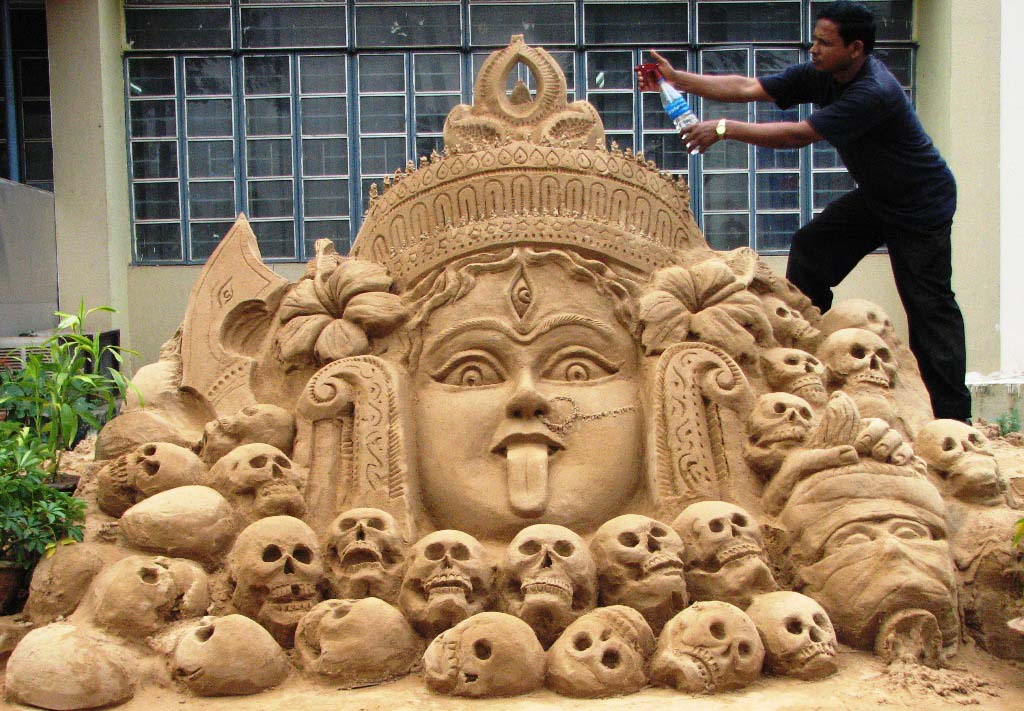
A majority of the temporary pandals house a particular iconography of Goddess Kali, who steps on Lord Shiva wearing a garland of human skulls and her tongue piercing out. This form is called 'Tara'; her colour is blue and she is shown naked to the waist, wearing a garland of human heads and then clad in tiger skin. The only puja committee that worships the 'Chhinamasta' form of the deity is the Bakhrabad Kali Puja Committee. Here, the deity holds her own severed head in one hand and a scimitar in another.
Three jets of blood spurt out of her bleeding neck and are drunk by her severed head and two other attendants. Instead of standing on Lord Shiva, the Goddess steps over an embracing man and woman on a lotus.


Like Durga Puja, the idol of Goddess Kali at several pandals is accompanied by a silver backdrop (Chandi Medha). Bhikari Das, general secretary of Cuttack Mahanagar Peace Committee said this year, at least 23 idols of Goddess Kali are being set up with Chandi Medhas. While the same backdrop is used for both Durga Puja and Kali Puja in other pandals, only Bakhrabad has a different tableau for the Tantric Goddess. Designed with traditional silver filigree work, the tableau depicts the scene of a cremation ground with two skeletons standing beneath a large banyan tree besides, jackals, owls, and swans being the dominating motifs. Two years back, the Bakhrabad puja committee prepared a beautiful golden crown to the deity. Some of the other Kali Puja pandals worth seeing are the ones at Ranihaat, College Square, Bajrakabati, Khan Nagar, Tulasipur, Bangali Sahi, Choudhury Bazaar and Sutahaat. Kali Puja begins on November 10 and culminates with Diwali. All the idols will be immersed on November 14.


In Bhadrak, Kali Puja is celebrated in a grand way owing to the presence of Bhadrakali temple. Like Durga Puja in Cuttack, Kali Puja in this coastal town is a week-long affair that is witnessed by lakhs of people. While a large number of devotees throng the Bhadrakali village, on the outskirts of Bhadrak town, several glittering pandals are erected in Charampa area to house the deity.

Likewise, Puri witnesses a grand gathering on the day of Diwali as people observe 'Badabadua Daka' to pay obeisance to their ancestors. In the unique ritual, people gather outside the 12th century Jagannath temple and burn jute sticks (known as Kaunriya Kathi in local parlance) inviting their ancestors to descend from heaven on Diwali and bless them. The burning of jute sticks is accompanied by a prayer 'Badabadua Ho Andhaare Aasa, Aalua Re Jao (Ancestors, come in darkness and go back along the lighted path). With thousands of bundles of jute sticks being lighted on the day, the Grand Road in front of the Jagannath temple offers a beautiful spectacle.


 Trips To Roads Less Travelled Wishes All Its Readers A Very Happy, Safe and Eco-friendly Diwali. Eat. Pray. Enjoy.

Monday, October 19, 2015

Celebrating Tradition

 
Madhubani painting of 18-armed Devi Durga by Vibhooti Jha

Durga Puja is is the only time of the year when around 2000 Bengalis of Bhubaneswar come together for community bonding. The Kalibari Durga Puja Samiti, on its part, takes care to offer them a taste of authentic Bengali tradition. For the Kalibari Samiti in Bhubaneswar, this is the 52nd year of Durga Puja celebration. While for the Telugus and Gujaratis in the city, puja celebrations begin with 'Navaratri', it is post 'Panchami' that the festivity starts for Bengalis.
"Our forefathers - Ashutosh Rai Choudhury, Bhaumik Ghosh and Satyaranjan Dey - established the Kalibari temple and puja samiti here at Ashok Nagar in 1964. Every year, we also welcome people of other communities to join us," says secretary of the Kalibari Durga Puja Samiti, S Marik. There are around 500 Bengali families in the Capital City who participate in the week-long Durga Puja celebration, which begins with 'Sasthi Puja' on October 19.


An artist paints the Durga idol at kalibari Puja Samiti in Bhubaneswar. Pic by Biswanath Swain
Unlike other parts of the city where Durga Puja is more about massive pandals, light decorations, 'Ravana Podi' and firecrackers, the focus here is just on the rituals and community get-together. Although the samiti members never erect an expensive pandal to welcome devotees, the 'Ekchala' idol of the deity is crafted by Bengali sculptors who are roped in from West Bengal. "The money that is earned through sale of 'bhog' during the puja goes into socially-relevant purposes," says Marik.
This year, a host of cultural activities will also be a part of the festivity. There will be a dance drama 'Mahisasura Mardini' on 'Ashtami' followed a competition on blowing conches and Dhunuchi Naach (traditional Durga Puja dance) in the evening. Interestingly, both the 'Navami', 'Dashami' rituals, 'Sindoor Khela' will be observed on October 22 and the idol will be immersed in the evening. 


Marik says Sandhi Puja on 'Ashtami' is the most important ritual of Durga Puja for the community. "During the Sandhi Puja that marks the transition from Ashtami to Navami, usually a period of 45 to 50 minutes, the Goddess is believed to take the form of Chamunda to kill Mahisasura. Intense prayers are done during this period and the Mother Goddess is offered 108 Lotus flowers and as many ghee lamps are lit," he says, adding that the samiti has never deviated from this tradition so far. 
Yet another attraction of the Kalibari Samiti during the puja is the 'Khicidi Bhog' that is offered to the Goddess and relished by devotees after 'Ashtami' Puja. The puja samiti often ropes in cooks from Kolkata to prepare the 'Khichidi', while the other dishes in the fare like 'Luchi', 'Dal', Chutney' and 'Payas' are prepared by Odia cooks from Bhubaneswar.
Apparently, apart from Bhubaneswar, Odisha has Kalibari Samiti only in Sambalpur besides, a Durgabari in Puri that celebrate the biggest festival of the Bengali community.

The Unique Two-armed Devi of Odisha

The Goddess in Biraja Kshetra has only two hands and the prototype of this image is found nowhere else in the country
Odisha is home to several sculptural representations of Mahisasuramardini Durga. One of the rarest representation, though, is of the two-armed Goddess at Biraja temple, also known as Biraja Kshetra in Jajpur district. Here, Goddess Durga is worshipped by the name of Biraja and historians believe this to be the earliest representation of Shakti Cult in Odisha.  

Located in Jajpur town, the present 70-ft-high temple housing the two-armed Goddess was built in 13th century while the idol dates back to the pre-Gupta or Gupta period. In fact, historian Sunil Patnaik says the idol might date back to 2nd century AD. The Goddess in Biraja Kshetra has two hands, in one hand she pierces the chest of Mahishasura with a spear and in other, she pulls tail of the demon.
The Mahishasura is depicted as a buffalo and the presiding deity's right foot presses the head of the animal. She wears a crown that has the symbolism of Lord Ganesha, a Shiva Linga and a crescent moon and a Shivalinga. The prototype of this image is found nowhere else in the country.
Apparently, the perimeter of the Biraja Kshetra is triangular in form and the extreme points of the triangle in western, south-eastern and north-eastern directions are guarded by Shiva Lingams, who are regarded as guardian deities of the Kshetra. Goddess Biraja is seated in the circumcenter of the triangular region. According to the temple management, the temple was renovated by Pratap Rudra Dev of Suryavanshi Gajapati dynasty.
While the temple complex has many other temples of Lord Shiva, Hanuman, Goddess Bagalamukhi and Markandeswar, the added attraction is a holy  pond 'Brahmakunda', which lies to  the northwest and close to the Biraja temple. The pond is so named as it is believed that Lord Brahma had conducted a yagna here.


 Maheswar Panigrahy, Sub-Collector of Jajpur and also the Chairman of Biraja Temple Managing Committee, says the temple sees a footfall of at least 1000 devotees everyday. On occasions like Durga Puja and Savitri, the footfall rises to 35,000 daily.  One of the most interesting aspects of Devi worship at Biraja Kshetra is Rath Yatra of Goddess Biraja, which is held during Dussehra. Her chariot, Shimhadhwaja, carries the deity in a ceremonial procession around the temple compound once a day for nine days.  There is a greater inflow of devotees to the temple from Southern Indian States like Andhra Pradesh, Karnataka and Tamil Nadu besides, the neighbouring West Bengal.
Panigrahy further says the State Government is now considering to develop a religious circuit comprising the Biraja temple, Baldevjew temple in Kendrapara, Sarala temple in Jagatsinghpur and Akhandalmani temple in Bhadrak. In fact, the Tourism Secretary LN Gupta had recently urged the Union Tourism Secretary Vinod Zutshi to consider inclusion of Biraja temple-Sarala-Akhandalamani-Baladevjew-Lalitgiri- Ratnagiri-Udayagiri under 'Swadesh Darshan' scheme of the Ministry.

Travellers Info

The temple is located at a distance of 125 km from Bhubaneswar and can be approached by road and rail. It has all amenities for tourists and for accommodation, the Odisha Tourism Development Corporation (OTDC) has a Panthasala. Besides, there are the PWD Bunglow and Circuit House in Jajpur town. Best time to visit is between October and January.


Wednesday, September 30, 2015

A Cultural Kaleidoscope That Puri Is

 Puri has always been a fresh canvas to the photographer’s eye. The centuries-old town exudes a raw charm and unforgettable warmth. TRLT brings you glimpses of different colours and tastes of the town, captured during a recent photo walk.

The 12th century Jagannath Temple at Puri


Aruna Stambha Outside the Jagannath Temple. It is said that Aruna is the  charioteer of God Surya. The Pillar is 32-ft-high and is made of high-quality granite. Lord Aruna is sitting atop Pillar with folded hands looking towards the Deities.

The sculpture of a Lion preying on an Elephant beneath the Aruna Stambha
Devotees at the Lion's Gate of Jagannath Temple


Khaja, also known as Pheni, is a very famous Odia sweet and it is one among the Chappan (56) varieties of 'bhog' (Mahaprasad) offered to Lord Jagannath. Legends say Lord Jagannath appeared in the dream of a man from Puri and instructed him how to prepare it.
Hardly two kilometres away from the Temple, begins the Puri Beach, a destination that certainly needs no introduction.  The Puri beach is the most popular beach in Odisha and the largest in the country. It stretches up to seven km and is a round-the-year destination for both domestic and international travellers. Visitors can enjoy both the sunrise and the sunset, sunbathe, sit back on the beach and watch local fishermen pulling their catch or mending their nets and listen to the melodious rendition of the striking waves.

Compared to other beaches in the country, the Puri Beach is considered to be safer as it does not face high tide and undercurrent very often. High tides occur only during full moon, so taking a bath in the sea is an enjoyable experience. The area near the beach is dotted with hotels and lodgings for travellers of all categories. For food lovers, there are several shacks along the beach selling fried and grilled seafood like prawns, crabs and pomfrets, freshly caught from the sea, along with vegetable pakodas. There are also many shops selling Odisha handlooms and seashell handicrafts. There is a lighthouse which remains open from 4 pm to 6 pm. One can get a spectacular view of the sea and the beach from the top of the lighthouse. 

The view outside my window at the OTDC Hotel
 

A tea shop by the Sea
 

Fishermen get busy checking their nets after returning with a Catch from the Sea

Their Catch

Shells for Sale
Clouds Approach the Puri Beach

Overcast
An old building in the vicinity
 Puri offers a lot in terms of places to eat. Being a Beach Town, Puri is a sea-food lover's paradise. There are shacks on the beach that prepare the seafood caught by the local fishermen. Select your fish, get it prepared and savour it watching the sunset.
While Odia and Bengali delicacies are easy to find, one can also check out restaurants offering Italian, Continental and Awadhi cuisine. Even pure vegetarian restaurants are not hard to find. Try Promphet Fry at 'Gaan' restaurant of Fort Mahodadhi, Prawn Sizzlers and Desi Chicken at Wild Grass or a delectable choice of Pastas and Pancakes at Hotel Honey Bee Bakery and Pizzeria.  


Rice Noodles and Chicken at Hotel Lee Garden. Head to this beautiful place if You want to taste authentic Chinese food

Chicken Curry at OTDC

Puri Sabzi for Breakfast

Honey, Banana Pancake with Ice-cream at Hotel Honey Bee Bakery and Pizzeria

Pasta with Tomato sauce, Sausage, pickled Olives and some India Masalas at Honey Bee Bakery and Pizzeria. The place is small but they serve awesome food

OTDC plays a perfect host
It starts raining in the evening
Lush green land on the outskirts of Puri


 Travellers' Info: 
Puri is located at a distance of 59 km from Bhubaneswar by road and 63 km by rail. Visitors can either hire a taxi or take a bus to Puri. There are plenty of options for accommodation near the Beach area. Best time to visit is from July to February.   Places to see nearby are the Sun Temple at Konark, Raghurajpur Crafts Village, Satpada, Chilika Lake and Alarnath.
Related Posts Plugin for WordPress, Blogger...